4.5 Tutorial: Advanced Study Composition with Units
In Tutorial: Composing Studies you learned how to embed one study inside another, and how to share a variable between them. That approach works well when the parent and child are written together and agree on the names of the variables they share.
This tutorial goes one step further. It shows how to write studies as interchangeable parts, so that a parent study can plug in any one of them without knowing what’s inside, hand a value in, and get a value back out. You’ll learn how to:
Describe the “plugs” a study needs and provides, using a signature
Write a study as a unit that fits those plugs
Compose several units into one study, in a fixed order
Compose units so that each participant gets one of them, chosen at random
Write the surrounding study once, as a function that composes any number of units
This tutorial assumes you’re familiar with the basic concepts covered in Congame basics: An overview and Introduction: a quick tour using Conscript, and that you’ve read Tutorial: Composing Studies.
4.5.1 The problem
Suppose your lab has written studies for two small tasks. In the counting task, participants solve addition problems and report how many they solved, earning ten cents per problem. In the lottery task, participants choose between a sure payment and a coin flip. Each task’s study is complete on its own, and each one pays the participant something.
Now you want a single study that shows a consent page, has the participant do a task, and then shows them what they’ll be paid. Inside that larger study, the parent, each task’s study runs as a substudy: a study that runs as one step of the parent. There are two versions you’d like to be able to build. In the first, every participant does both tasks, one after the other. In the second, each participant is randomly given just one of the tasks.
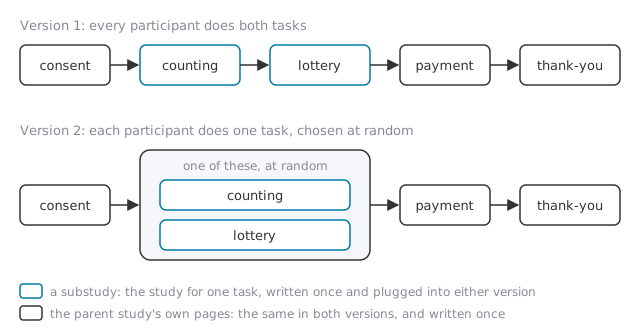
And once both work, you’d like the parent’s own pages, the consent page, the fee, and the payment page, to be written once and used again with whatever substudies the lab writes next, without editing them each time.
Two pieces of information have to cross the line between the parent and the substudy inside it. The participation fee is decided by the parent, but the substudy needs to know it, because its instructions mention it. And the payment is worked out by the substudy, but the parent needs it, because the parent owns the payment page.
You could handle this with the defvar* technique from the previous tutorial: agree on a variable name for the fee and another for the payment, and have both sides use them. That is fine for one parent and one child. It gets awkward when you want any substudy to fit into the same place in the parent, when a substudy needs to hand back a calculation rather than a number, or when nothing checks that a substudy actually provides what the parent expects until a participant hits the missing piece. Racket’s units solve exactly this problem.
4.5.2 What a unit is
Think of a signature as the shape of a plug, and a unit as a study packed in a box with plugs on it. One plug is for what goes in, and the others are for what comes out.
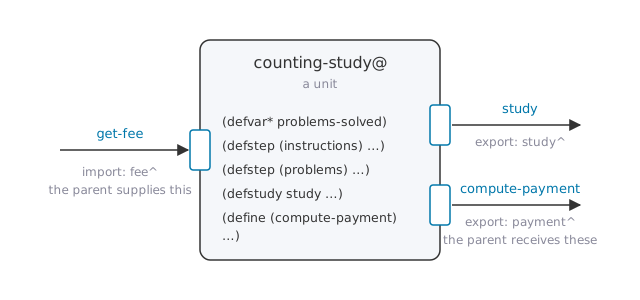
A signature is just a list of names. This tutorial uses three of them. The fee^ signature names one function, get-fee, which returns the participation fee. The study^ signature names study, the study itself. The payment^ signature names compute-payment, a function that returns what the substudy pays the participant. By convention, signature names end in a caret (^) and unit names end in an at-sign (@).
A unit is a block of code that imports some signatures and exports others. Importing fee^ means “somebody outside will give me a function called get-fee”. Exporting study^ and payment^ means “I promise to define study and compute-payment, and the outside can have them”.
A unit is not a study. It is a recipe for making a study, and the recipe can’t be followed until someone supplies the imports. You do that with define-values/invoke-unit, which takes the unit and the imports, runs the unit’s code, and defines its exports for you. Keep this last point in mind: invoking a unit defines names in whatever scope you’re standing in when you do it. Nearly every mistake people make with units comes from forgetting that.
Units are a general Racket feature, not something specific to Congame. For the full story, see Units in the Racket Guide.
4.5.3 The signatures
The signatures go in a file of their own, apart from any study. Create "signatures.rkt":
"signatures.rkt"
#lang conscript (provide fee^ study^ payment^) (define-signature fee^ [get-fee]) (define-signature study^ [study]) (define-signature payment^ [compute-payment])
There are two reasons to keep the signatures apart from the studies. The first is the same reason you’re composing studies at all: you are factoring out the parts that every piece has in common, and the signatures are the most common part of all. Every substudy and every parent study needs them.
The second reason is a rule of Racket’s. Two signatures are only “the same” if they come from the same definition. If "counting-study.rkt" defined its own fee^ and the parent study defined another one, they would be two different signatures that happen to share a name, and the parent could never plug the substudy in. Defining each signature once, outside the files that define the studies, and require-ing that definition everywhere is what makes the plugs fit.
This tutorial keeps its three signatures together in one file. That part is a matter of taste. Some authors prefer one file for each signature, and Racket has a small language for writing a file that way: see racket/signature.
4.5.4 Writing a substudy as a unit
Here is the substudy for the counting task, written as a unit. Save it as "counting-study.rkt":
"counting-study.rkt"
#lang conscript/with-require (require conscript/form0 conscript/survey-tools "signatures.rkt") (provide counting-study@) (define counting-study@ (unit (import fee^) (export study^ payment^) (with-namespace my-lab.counting-study (defvar* problems-solved)) (define (compute-payment) (* 0.10 problems-solved)) (defstep (instructions) @md{# Counting task On the next page you will see ten addition problems. Solve as many as you can in your head, then tell us how many you solved. You will earn $0.10 for each problem you solve, in addition to your @(~$ (get-fee)) participation fee. @button{Start}}) (defstep (problems) (define-values (report-form on-submit) (form+submit [problems-solved (ensure binding/number (required) (range/inclusive 0 10))])) (define (render rw) @md*{@rw["problems-solved" @input-number{How many did you solve?}] @|submit-button|}) @md{# Problems 17 + 26, 38 + 45, 52 + 19, 64 + 27, 71 + 39, 83 + 48, 29 + 57, 46 + 35, 58 + 67, 92 + 13 @form[report-form on-submit render]}) (defstudy study [instructions --> problems --> ,(lambda () done)])))
If you have written a Conscript study before, most of this will look familiar. The steps and the defstudy that strings them together are exactly what you would write in a standalone study. What’s new is the wrapper around them, the name of the study, and a few details inside.
The file uses #lang conscript/with-require rather than plain #lang conscript, because it needs to require the sibling file "signatures.rkt". (See conscript/with-require for what this implies about who can upload the study.)
The whole body of the substudy sits inside (unit (import fee^) (export study^ payment^) ...), and the file provides the unit, counting-study@, rather than a study. Everything you would normally write at the top level of the file goes inside the unit instead, and defvar, defstep, and defstudy all work there just as they do outside.
The substudy’s flow, instructions then problems, is a study named study. That name is fixed: it is the name the study^ signature promises, and the parent will refer to the substudy by it. Every substudy exports its study under this same name. Telling the substudies apart is the parent’s job, not the substudy’s, and Why each substudy runs under a name of its own shows how the parent does it.
The fee is never written into this file. Wherever the text needs it, the code calls (get-fee), and it does so inside a step, at the moment the page is shown. The function get-fee is the import: this file doesn’t define it, and it doesn’t exist until the parent supplies it.
The study’s last transition is ,(lambda () done). When the participant leaves the problems page, the study is finished and hands control back to the parent, just as with any child study. The substudy does not have a thank-you page of its own, because the parent will provide one.
Finally, look at problems-solved. It is defined with defvar* inside a with-namespace block, not with plain defvar, and the reason deserves a careful explanation.
4.5.4.1 Why compute-payment needs a defvar*
Recall from Sharing Data Between Parent and Child that a defvar variable is stored under the study that sets it. All of the counting substudy’s own pages run inside the same study, so among themselves they could share a plain defvar without trouble.
But compute-payment is exported. The parent study calls it later, from a page of its own, which runs outside the substudy. If problems-solved were a plain defvar, the parent’s call would look for it in the parent’s own storage, find nothing, and get undefined. Making it a defvar* stores it in one shared place that both the substudy’s pages and the parent can reach. The with-namespace block gives that shared place a name that no other substudy will accidentally use; naming the namespace after the substudy, as here, is a good habit.
The lottery substudy shows both kinds side by side. Save it as "lottery-study.rkt":
"lottery-study.rkt"
#lang conscript/with-require (require conscript/form0 conscript/survey-tools "signatures.rkt") (provide lottery-study@) (define lottery-study@ (unit (import fee^) (export study^ payment^) (with-namespace my-lab.lottery-study (defvar* payoff)) (defvar choice) (define (compute-payment) payoff) (defstep (choose) (define-values (choice-form on-submit) (form+submit [choice (ensure binding/text (required))])) (define (render rw) @md*{@rw["choice" (radios '(("safe" . "Take $1.00 for sure") ("risky" . "Flip a coin: heads pays $3.00, tails pays nothing")) "Which do you prefer?")] @|submit-button|}) @md{# Lottery choice Your @(~$ (get-fee)) participation fee is yours to keep whatever you choose here. @form[choice-form on-submit render]}) (defstep (flip) (set! payoff (if (equal? choice "safe") 1.00 (if (zero? (random 2)) 3.00 0.00))) (skip)) (defstep (result) @md{# Result You chose the @(if (equal? choice "safe") "safe" "risky") option and earned @(~$ payoff). @button{Continue}}) (defstudy study [choose --> flip --> result --> ,(lambda () done)])))
Here choice is a plain defvar, because only the substudy’s own pages read it. The coin is flipped in a step of its own, flip, which stores the result and then calls skip so that the participant never sees a page for it. (Flipping the coin inside the result page would flip it again every time that page was reloaded.) The result goes into payoff, which is a defvar* because compute-payment reads it.
4.5.4.2 Converting a study you’ve already written
If you have an existing standalone study and want to turn it into a unit, the changes are the ones you have just seen. The steps below are written for any set of signatures, not just the three in this tutorial, and it helps to make them in order.
Change the first line to #lang conscript/with-require and require the file that defines the signatures you are going to use. In this tutorial that file is "signatures.rkt".
Wrap everything below the require in (define my-study@ (unit (import ...) (export ...) ...)). Under import, list the signatures for the things the study needs from outside; under export, list the signatures for the things it provides. Then change the provide so that the file provides the unit instead of the study. The substudies in this tutorial import fee^ and export study^ and payment^.
For each name in an imported signature, find the places where the study used to supply that value itself, and replace them with the imported name. Call imported names from inside a step, at the moment the page is shown, never at the top level of the unit. In the counting substudy, the fee that used to be typed into the text became a call to (get-fee).
For each name in an exported signature, make sure the unit defines something with exactly that name. If one of the exports is the study itself, rename its defstudy to the name the signature promises, give its last page a button, make its last transition ,(lambda () done), and remove any thank-you page that the parent will provide instead. Here the study is renamed study, because that is the name study^ promises.
Any study variable that an exported function reads must become a defvar* inside a with-namespace block named after the study. Here compute-payment reads problems-solved, so problems-solved is a defvar*.
4.5.5 The shared pages
The consent page and the closing pages are the same no matter which task a participant does, so they live in a file of their own. Save this as "shared-pages.rkt":
"shared-pages.rkt"
#lang conscript (provide consent no-consent thank-you consent-given? participation-fee) (require conscript/form0 conscript/survey-tools) (with-namespace my-lab.shared-pages (defvar* participation-fee)) (defvar consent-given?) (defstep (consent) (define-values (consent-form on-submit) (form+submit [consent-given? (ensure binding/text (required))])) (define (render rw) @md*{@rw["consent-given?" (radios '(("yes" . "Yes, I agree to take part") ("no" . "No, I do not want to take part")) "Do you agree to take part in this study?")] @|submit-button|}) @md{# Welcome You will receive @(~$ participation-fee) for taking part, plus whatever you earn in the task. @form[consent-form on-submit render]}) (defstep (no-consent) @md{# Thank you for your time You have chosen not to take part. You may close this window.}) (defstep (thank-you) @md{# Thank you! Your responses have been recorded. You may close this window.})
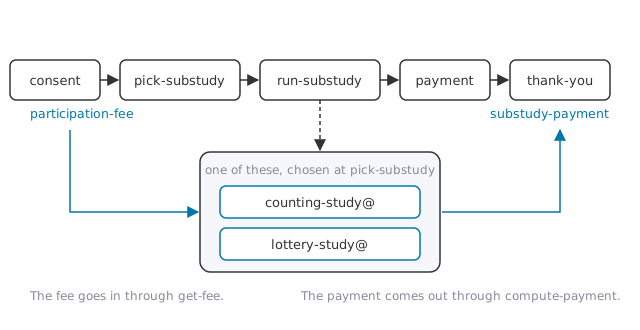
This file owns the participation fee. It is a defvar* for the same reason as before, seen from the other side: the parent study sets it, and the substudies read it (through get-fee) from inside their own studies. A plain defvar set by the parent would be invisible to them.
4.5.6 Part 1: Composing in a fixed order
Now for the first parent study, where every participant does the counting task and then the lottery task. Save it as "fixed-study.rkt":
"fixed-study.rkt"
#lang conscript/with-require (require conscript/survey-tools "counting-study.rkt" "lottery-study.rkt" "shared-pages.rkt" "signatures.rkt") (provide fixed-study) (define-values (counting-study compute-counting-payment) (let () (define (get-fee) participation-fee) (define-values/invoke-unit counting-study@ (import fee^) (export study^ payment^)) (values study compute-payment))) (define-values (lottery-study compute-lottery-payment) (let () (define (get-fee) participation-fee) (define-values/invoke-unit lottery-study@ (import fee^) (export study^ payment^)) (values study compute-payment))) (defstep (set-fee) (set! participation-fee 2.00) (skip)) (defstep (payment) @md{# Your payment Participation fee: @(~$ participation-fee) Counting task: @(~$ (compute-counting-payment)) Lottery: @(~$ (compute-lottery-payment)) Total: @(~$ (+ participation-fee (compute-counting-payment) (compute-lottery-payment))) @button{Continue}}) (defstudy fixed-study [set-fee --> consent --> ,(lambda () (if (equal? consent-given? "yes") 'counting-study 'no-consent))] [counting-study --> lottery-study --> payment --> thank-you --> ,(lambda () done)] [no-consent --> ,(lambda () done)])
The interesting part is the two define-values blocks near the top. Each one unpacks a unit. Read the first one slowly. Inside a (let () ...) block, it defines get-fee, which is the import the unit asked for. Then define-values/invoke-unit runs the unit’s code, supplying that import and defining the two exports, study and compute-payment, right there inside the let. Finally, values hands those two things out of the let, where define-values gives them the names counting-study and compute-counting-payment.
Why the let? Because invoking a unit defines its exports in the surrounding scope. If you invoked both units at the top level of the file, the second would try to define study a second time, and Racket would refuse with . The let gives each invocation a small private scope. The exports are defined in there, you pick the ones you want to keep, and you give them names that won’t clash.
The get-fee you define inside the let is not passed to the unit as an argument. The unit finds it by name, in the scope where it is invoked. That is why it has to be defined right there, and it has to be called exactly get-fee. It returns participation-fee, which is the defvar* from the shared pages.
After that, the rest of the file is an ordinary Conscript study. counting-study and lottery-study are studies, so they go into the transition graph like any other child study. Each substudy is a step of its own there, under its own name, so each one also stores its data under its own name; Why each substudy runs under a name of its own explains why that matters. The set-fee step stores the fee and skips ahead. The payment page calls the two exported functions and adds up the total. The consent transition sends participants who decline to the no-consent page and everyone else into the counting substudy.
Upload "fixed-study.rkt" to your Congame server and try it. The uploader will bundle the other four files for you, as long as they are in the same folder. If you report solving seven problems and take the sure payment, the payment page will show a $2.00 fee, $0.70 for counting, $1.00 for the lottery, and a total of $3.70.
4.5.7 Part 2: Choosing a substudy at random
In the second version, each participant does one task, chosen at random when they reach that point in the study. The parent study can’t unpack the substudy’s unit at the top of the file any more, because it doesn’t know which one it will need until the participant arrives.
Save this as "randomized-study.rkt":
"randomized-study.rkt"
#lang conscript/with-require (require conscript/survey-tools "counting-study.rkt" "lottery-study.rkt" "shared-pages.rkt" "signatures.rkt") (provide randomized-study) (with-namespace my-lab.randomized-study (defvar* selected-substudy) (defvar* substudy-payment)) (define substudies (list (cons 'counting counting-study@) (cons 'lottery lottery-study@))) (defstep (set-fee) (set! participation-fee 2.00) (skip)) (defstep (pick-substudy) (set! selected-substudy (car (list-ref substudies (random (length substudies))))) (skip)) (defstep/study run-substudy #:study (lambda () (define substudy@ (cdr (assq selected-substudy substudies))) (define (get-fee) participation-fee) (define-values/invoke-unit substudy@ (import fee^) (export study^ payment^)) (define (record-payment) (set! substudy-payment (compute-payment)) (skip)) (defstudy substudy-then-record [{,selected-substudy study} --> record-payment --> ,(lambda () done)]) substudy-then-record)) (defstep (payment) @md{# Your payment Participation fee: @(~$ participation-fee) Task (@(symbol->string selected-substudy)): @(~$ substudy-payment) Total: @(~$ (+ participation-fee substudy-payment)) @button{Continue}}) (defstudy randomized-study [set-fee --> consent --> ,(lambda () (if (equal? consent-given? "yes") 'pick-substudy 'no-consent))] [pick-substudy --> run-substudy --> payment --> thank-you --> ,(lambda () done)] [no-consent --> ,(lambda () done)])
The list substudies pairs a name with each unit. Adding a third substudy to this study means adding one more pair to this list, and nothing else. In Part 3: A function that composes any substudies, the list itself becomes an argument.
The pick-substudy step picks a name at random, stores it in selected-substudy, and skips ahead. The choice is made here, in a step of its own, and written down before anything uses it. The next section explains why that matters.
The run-substudy step is where the unit gets unpacked. Recall from Dynamic Study Generation that defstep/study accepts a procedure that builds the child study when the step is reached. That procedure is the lambda here, and its body does the same unpacking as the let blocks in Part 1: it looks up the chosen unit, defines get-fee, and invokes the unit, which defines study and compute-payment inside the lambda. Then it builds a two-step study that runs the chosen substudy and, once it is done, copies the substudy’s payment into substudy-payment. That little study is what the lambda returns, and it is what the participant runs.
The first step of that little study is written {,selected-substudy study}. It runs the unit’s study, but as a step named after the chosen substudy, counting or lottery, rather than as a step named study. This is the {,step-id-expr step} form of defstudy, which computes a step’s name when the study is built. Why each substudy runs under a name of its own explains why the name matters.
The lambda is a private scope, just as the let was. Nothing it defines leaks out into the rest of the file, so it doesn’t matter that every unit exports the same two names.
There is one thing this version gives up. In Part 1 the units were invoked when the file was loaded, so a unit that didn’t fit its plugs was rejected the moment you uploaded the study. Here the unit is invoked inside the lambda, which runs only when a participant reaches run-substudy, so a unit that doesn’t fit is discovered only then. Part 3: A function that composes any substudies gets the early check back.
Two more variables are defvar* here, and neither has anything to do with the signatures. substudy-payment is set inside run-substudy and read on the payment page, which is outside it. selected-substudy is set in pick-substudy and read on the payment page too. Both cross a study boundary, so both need to be shared. This is the general form of the rule from earlier: whenever a value is written inside one study and read from another, it must be a defvar*.
Upload "randomized-study.rkt" and run through it a few times in different private browser windows. Some participants will get the counting task and others the lottery, and the payment page names whichever task they did.
4.5.7.1 Why the choice is made in its own step
You might wonder why pick-substudy exists at all. Couldn’t the lambda in run-substudy just call random itself?
The reason is that the lambda runs every time a participant enters the run-substudy step, and that can happen more than once. If a participant closes the browser halfway through the task and later returns to the study, Congame walks them back to where they were, and entering run-substudy again runs the lambda again. If the lambda picked at random, it might pick a different substudy the second time. Congame would then try to resume the participant at a step of a study they were never in, which either fails with an error or, if the two substudies happen to have a step with the same name, silently drops them into the wrong one.
So the lambda must make the same decision every time it runs. The way to guarantee that is to make the decision once, in a step, store it in a defvar*, and have the lambda only look it up. The lambda should not roll dice, count anything, or change any variable. It reads stored values and builds a study, nothing more.
The stored choice does a second job in the lambda: it names the step the substudy runs in. That name must also be the same every time, because Congame finds a returning participant’s place by the names of the steps they are in. Because selected-substudy is stored, the name is the same every time.
4.5.7.2 Why each substudy runs under a name of its own
In "randomized-study.rkt", the lambda runs the substudy as {,selected-substudy study} rather than simply as study. The reason has to do with how Congame files away what a substudy stores.
Recall from Sharing Data Between Parent and Child that a defvar is stored under the study that sets it. More precisely, every stored value is filed under a path: the names of the steps the participant passed through to reach the page that stored it, from the outermost study inward, where each name is the one used in the enclosing study’s transition graph. The name a study gives itself in defstudy plays no part.
In "fixed-study.rkt", each substudy is a separate step of the parent, under its own name, so the counting substudy’s pages store their values under counting-study and the lottery’s under lottery-study. The paths are already different, and there is nothing more to do.
"randomized-study.rkt" is different. Whichever substudy a participant is given, it runs inside the same run-substudy step. If the lambda’s little study were written [study --> record-payment --> ...], the substudy would always be the step called study, because that is the name every unit exports. So the path to every substudy’s pages would be the same, run-substudy / study, and both substudies would store their variables at the same path. For a value that only one participant ever touches, that is merely untidy: you would need selected-substudy to tell which substudy a row of data came from. For a value shared by all participants in the instance, it is an error. Suppose each substudy kept a defvar/instance named treatments, the list of conditions still to be handed out. One list would serve both substudies, and each would hand out the other’s conditions. The state that make-matchmaker keeps for a study is stored at the path too, so two substudies that each match participants into pairs would draw from one shared pool, and a participant in the counting task could be paired with one in the lottery.
The {,selected-substudy study} form prevents this. It runs the same study, but as a step named by the value of selected-substudy. So the counting substudy’s pages store their values under run-substudy / counting, and the lottery’s under run-substudy / lottery. Each substudy has a path of its own, everything it stores by position stays apart from the other one’s, and the data itself records which task the participant did.
This is the parent’s job, not the substudy’s. A unit exports its study under the name its signature promises, and it cannot know how a parent will use it. Only the parent knows whether one of its steps can run more than one unit, and so only the parent needs to give each unit a name of its own.
One helper works differently: assigning-treatments from conscript/survey-tools stores its list of remaining treatments at the top level of the study, outside any path, so two substudies that both call it must be told apart with its #:treatments-key argument.
4.5.7.3 Keeping a substudy runnable on its own
A unit can’t be uploaded and run by itself, because it is only a recipe for a study. If you also want to run its study on its own, for testing or because it is a study in its own right, you can make a standalone version by invoking the unit once at the top of its own file and supplying fixed values for its imports. For the counting substudy the only import is the fee. Add this to the bottom of "counting-study.rkt":
(define counting-study-alone (let () (define (get-fee) 2.00) (define-values/invoke-unit counting-study@ (import fee^) (export study^ payment^)) study))
and change the provide at the top of the file to (provide counting-study@ counting-study-alone). The unit and the standalone study live in the same file, and the standalone study is built from the unit, so there is only one copy of the substudy to maintain.
4.5.8 Part 3: A function that composes any substudies
"randomized-study.rkt" does its job, but it is still a study about the counting and lottery substudies. If another experiment in your lab wanted the same consent page, the same fee, the same random choice, and the same payment page around three other substudies, you would copy the file and edit the list. Nothing in the file except that list depends on which substudies it runs, and that suggests the last step: turn the parent into a function whose arguments are the substudies.
The function goes in a file of its own. Save it as "compose-substudies.rkt":
"compose-substudies.rkt"
#lang conscript/with-require (require conscript/survey-tools "shared-pages.rkt" "signatures.rkt") (provide compose-substudies) (with-namespace my-lab.compose-substudies (defvar* selected-index) (defvar* substudy-payment)) (define (compose-substudies #:fee [fee 2.00] . substudy@s) (when (null? substudy@s) (raise-argument-error 'compose-substudies "at least one substudy unit" substudy@s)) (define (check-fit substudy@) (define (get-fee) fee) (define-values/invoke-unit substudy@ (import fee^) (export study^ payment^)) (void)) (for-each check-fit substudy@s) (defstep (set-fee) (set! participation-fee fee) (skip)) (defstep (pick-substudy) (set! selected-index (random (length substudy@s))) (skip)) (defstep/study run-substudy #:study (lambda () (define substudy@ (list-ref substudy@s selected-index)) (define substudy-id (string->symbol (format "substudy-~a" selected-index))) (define (get-fee) participation-fee) (define-values/invoke-unit substudy@ (import fee^) (export study^ payment^)) (define (record-payment) (set! substudy-payment (compute-payment)) (skip)) (defstudy substudy-then-record [{,substudy-id study} --> record-payment --> ,(lambda () done)]) substudy-then-record)) (defstep (payment) @md{# Your payment Participation fee: @(~$ participation-fee) Task: @(~$ substudy-payment) Total: @(~$ (+ participation-fee substudy-payment)) @button{Continue}}) (defstudy composed [set-fee --> consent --> ,(lambda () (if (equal? consent-given? "yes") 'pick-substudy 'no-consent))] [pick-substudy --> run-substudy --> payment --> thank-you --> ,(lambda () done)] [no-consent --> ,(lambda () done)]) composed)
The study you upload is now a separate, very short file. Save it as "composed-study.rkt":
"composed-study.rkt"
#lang conscript/with-require (require "compose-substudies.rkt" "counting-study.rkt" "lottery-study.rkt") (provide composed-study) (define composed-study (compose-substudies counting-study@ lottery-study@))
Most of "compose-substudies.rkt" is "randomized-study.rkt" moved inside a function. defstep, defstep/study, and defstudy are definitions, and definitions can live inside a function body just as they live at the top of a file. Each call to compose-substudies runs those definitions afresh and builds a new study around the units it was given; the steps refer to substudy@s, the list of arguments, the way the steps in Part 2 referred to the list substudies. The last expression in the function is the study, which is what the function returns and what "composed-study.rkt" provides.
Two declarations stayed outside the function: the defvar* variables at the top of the file. They name places in the database, and those places are the same whichever substudies are passed in, so there is nothing to gain from redeclaring them on every call. Everything that depends on the arguments went inside.
The body of the function runs when the file is loaded, before any participant exists, just like the top level of a unit. That is why it only defines steps and checks its arguments, and reads nothing from a study variable. All the reading happens inside the steps, while a participant is on the page.
In Part 2 the parent knew its substudies by name, because it wrote the list itself. A function that accepts any substudies receives only the units, and a unit has no name. What the function does know is the order of its arguments, so pick-substudy now stores a position, drawn with random from the length of the list, and the lambda fetches the chosen unit with list-ref. The rule from Why the choice is made in its own step is unchanged: the decision is made in a step, stored, and only looked up by the lambda. What is stored has to be something the database can hold, and a number is; a unit is not.
Without names, the lambda also makes the substudy’s step name from the position: substudy-id is substudy-0 for the first argument, substudy-1 for the second, and so on. As Why each substudy runs under a name of its own showed, everything a substudy stores sits under a path that ends in that name, so the payment page no longer names the task, but the data still records which argument ran.
The fee became a keyword argument, #:fee, with a default of $2.00. In Part 2 the parent decided the fee on its own; now the caller decides it, or accepts the default. Anything else the parent used to decide for itself can move out the same way.
The one genuinely new piece is check-fit. A unit’s plugs are checked when the unit is invoked. In Part 1 that happened as the file was loaded, so a unit that didn’t fit was rejected at upload. In Part 2 the unit is invoked inside the lambda, so a unit that doesn’t fit is discovered only when a participant reaches run-substudy. check-fit invokes each unit once, right away, and discards the result. Its only purpose is the check: a unit that doesn’t export study^ and payment^ stops the file from loading, with a message naming the missing signature, and you see it the moment you upload. The guard above it does the same for the mistake of passing no substudies at all, which would otherwise surface as an error from random on the first participant’s screen.
Upload "composed-study.rkt". The uploader bundles "compose-substudies.rkt" and the substudy files along with it, and the study behaves exactly as "randomized-study.rkt" did. The difference is in what it costs to change. A third substudy is one more require and one more argument in "composed-study.rkt"; a second experiment with different substudies is another file as short as this one; and anything you add inside compose-substudies, a waiting room before the substudy, a balanced assignment in place of random, an extra page afterwards, reaches every study built from it without a change to any of them.
4.5.9 Guidelines
Almost everything that can go wrong with units follows from the same fact: invoking a unit defines its exports in the scope where you invoke it. The habits below keep you out of trouble whatever signatures your units use. Each comes with the error you’ll see if you break it, and with what it means for the substudies in this tutorial.
Unpack a unit inside a let or a lambda, never at the top of a file. Two units invoked at the top level that export the same name produce . Even a single unit at the top level is a bad habit, because the next one you add will collide with it. Here, every unit exports study, so unpacking two of them at the top of "fixed-study.rkt" would fail.
Define every import in the same scope, just before you invoke the unit, using exactly the names the signature uses. The unit finds its imports by name, not as arguments. If a name is missing you get for that name, and a definition under a different name, however sensible, doesn’t help. The only import in this tutorial is get-fee, so each let and the lambda define get-fee first.
Treat define-values/invoke-unit as a definition, not an expression. It can appear where a define can appear and nowhere else. Writing it inside (define s (begin ...)) or in the argument of a function call gives .
Call imported names from inside steps, not at the top level of the unit. The top level of a unit runs when the unit is invoked, which may be before any participant has arrived, or before the parent has set the values an import depends on. Here, (get-fee) reads participation-fee, which the parent sets in its set-fee step, so the substudies call it only while showing a page.
Use defvar* for anything that crosses between a unit’s study and the study around it. Inside a unit, that means every study variable an exported function reads. In the parent, it means anything written inside the step that runs the unit’s study and read outside it, or the other way around. Plain defvar is fine for values that stay within one study. Breaking this rule doesn’t produce an error message; it produces a page that shows undefined where a value should be. In this tutorial the shared variables are participation-fee, problems-solved, payoff, selected-substudy, and substudy-payment.
When one step can run more than one unit, give each unit’s study a step name of its own. In the parent, write the unit’s study as {,step-id-expr study}, not as study. Otherwise every unit runs under the same step name and keeps its instance variables, and the state behind make-matchmaker, in one shared place. There is no error message for getting this wrong, only a study that quietly mixes two substudies’ data. Here the names are counting and lottery in Part 2, and substudy-0, substudy-1, and so on in Part 3. A parent that gives each unit a step of its own, as Part 1 does, has nothing to do. The units themselves always export study.
Decide which unit to run in its own step, store the decision, and have the lambda only look it up. A lambda that makes its own random choice can choose differently when a participant resumes, and drop them into a different study partway through. Here the decision is made in pick-substudy and stored in selected-substudy, or, in Part 3, as a position in selected-index. Store the decision as something the database can hold, a name or a number, never the unit itself. Make the unit’s step name from the same stored decision.
When the parent is a function, keep the defvar* declarations outside it and everything else inside. The steps and studies belong inside, so that each call builds a fresh study around the units it was given; the variables name places in the database, which are the same whichever units are passed. The body of the function runs when the file is loaded, before any participant exists, so it may define steps and check its arguments, and it must not read a study variable. Here "compose-substudies.rkt" declares selected-index and substudy-payment at the top of the file and defines everything else inside compose-substudies.
Define each signature once, in a file apart from the studies. A signature defined twice is two different signatures, even with the same name, and a unit written against one cannot be plugged into a parent written against the other. Whether the signatures share one file or each have a file of their own is up to you. Here all three are in "signatures.rkt".
If a unit exports a study, end that study with ,(lambda () done) and give its last page a button. Without the done, control never returns to the parent. Without the button, the participant has no way to reach it.
Don’t keep participant data in a plain define inside a unit. The unit’s code runs again every time it is invoked, so anything stored that way is lost. Study variables made with defvar and defvar* are stored in the database and survive.
4.5.10 When to use units
Units are more machinery than most studies need. Any study can already be dropped into another study as a child, it can return control with done, and it can share values through defvar* variables that both sides agree on. If you have one parent and one or two children that were written together, that is the right tool, and Tutorial: Composing Studies covers it.
Reach for units when the pieces are interchangeable. If one place in a study has to accept any of several studies, chosen at run time, the signature is what makes them all fit, and the compiler checks the fit before any participant does. Reach for them when a piece must not know who is using it, because it will be used by several parents or with several settings, and you don’t want every parent to know the piece’s variable names. And reach for them when the parent needs a calculation from the piece rather than a number, since a signature can export a function and a defvar* can’t. And reach for them when the study around the pieces is worth writing once, as a function, and reusing with a different set of pieces each time, as in Part 3: A function that composes any substudies.
If none of those apply, use a plain child study.
4.5.11 Exercise
Write a third substudy, a short survey task that asks one question and pays a flat $0.50, as a unit in its own file. Add it as a third argument to compose-substudies in "composed-study.rkt", upload, and run through the study until you’ve seen all three tasks come up.
Then try leaving out the (export payment^) clause in your new substudy and uploading again. The error tells you, before any participant arrives, that the unit doesn’t fit the slot. That check is the reason for all of this.
4.5.12 Key concepts recap
A signature is a list of names. A unit imports the signatures for what it needs and exports the signatures for what it provides. Define each signature once, apart from the studies, where every unit and every parent can require it. This tutorial uses three: fee^, study^, and payment^.
Inside a unit, define every exported name exactly as its signature spells it, and call imported names only from inside steps. If one of the exports is a study, end it with ,(lambda () done).
Invoking a unit with define-values/invoke-unit defines its exports in the current scope. Always do it inside a let or a lambda, with every import defined right there.
For a fixed composition, unpack each unit in its own let at the top of the parent. For a random one, store the choice in a step, then unpack the chosen unit inside the lambda given to defstep/study.
Any value that crosses between studies, in either direction, must be a defvar*.
A unit exports its study under the name the signature promises. When one step of the parent can run more than one unit, the parent gives each unit’s study a step name of its own with {,step-id-expr study}, computed from the stored decision. That name gives everything the substudy stores a path of its own.
The parent can be a function. defstep, defstep/study, and defstudy work inside a function body, the defvar* declarations stay outside it, the stored decision is a position in the argument list, and invoking each unit once as the study is built rejects a unit that doesn’t fit at upload time.
4.5.13 Next steps
Look at congame-example-study/many-designs-composition/ for another worked example: three small studies, two of them units, composed in a fixed order.
Read Units in the Racket Guide for what else units can do, such as linking several units together.
Review the Conscript Reference for defstep/study, defvar*, and with-namespace.